- Lyricist
- Pattukkottai Kalyanasundram
- Singers
- Seerkazhi Govindarajan, P. Leela
- Music director
- G. Ramanathan
- Movie name
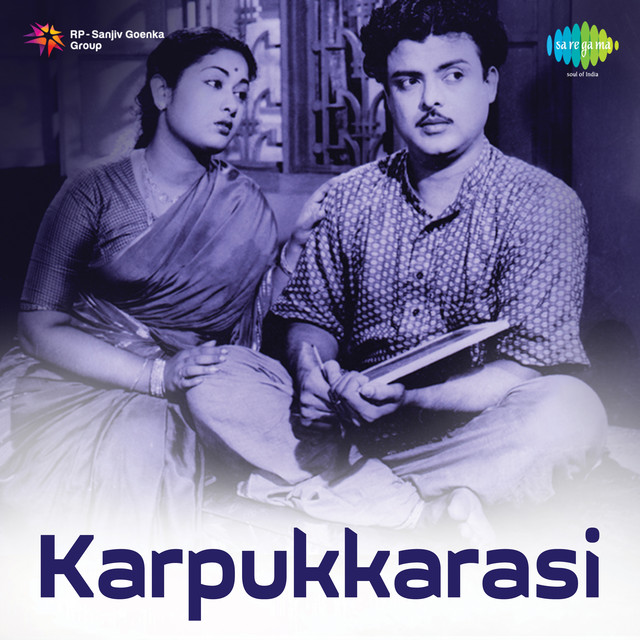
- Karpukkarasi
- Movie release year
- 1957
- Lyrics added on
- 19 Nov 2025
Lyrics & meaning
Beyond the translation
Overall song meaning
This classic duet from 'Karpukkarasi' (1957) creatively blends philosophical folk wisdom with playful romantic banter. The song opens with the famous ancient riddle about human life stages: four legs in infancy (crawling), two legs in youth/adulthood, three legs in old age (using a walking stick), and ten legs on the final journey (the four pallbearers with eight legs carrying the two-legged body on a bier). Lyricist Pattukkottai Kalyanasundaram uses this transient nature of life—where the physical body is merely an old shirt to be discarded—to emphasize living life to the fullest and cherishing present joy. As the song transitions, the conversation shifts to romantic alignment between lovers. Through evocative folk imagery, the female singer asks if the creeper should entwine the branch, if pitch should harmonize with voice, and if birds should pair up, to which the male singer eagerly consents, sealing their affectionate banter.
Writing craft
Poetic devices
Vidukathai / Allegorical Metaphor
“Thaththakkaa puththakkaa naalu kaalu... paththu kaalu”
Uses the classical riddle of four, two, three, and ten legs to describe human life stages from infancy to death.
Uvamaani (Metaphor)
“Sattaiyai kazhattu vitterinjaappilae / Kattaiyai vittuvittu pogumunnaalae”
Compares leaving the physical body (kattai) upon death to discarding an old shirt (sattai).
Edugai (Second-letter Rhyme)
“Sattaiyai kazhattu vitterinjaappilae / Kattaiyai vittuvittu pogumunnaalae”
The second consonant sound 'tta' is repeated across successive lines (Sattaiyai / Kattaiyai).
Iyaibu (End Rhyme)
“Suththattumaa / Serattumaa / Koodattumaa / Podattumaa”
The matching rhyming suffix '-attumaa' creates rhythm at the ends of consecutive female verses.
Did you know?
Trivia
Written by the iconic poet-lyricist Pattukkottai Kalyanasundaram, this song is famous for embedding profound philosophy into catchy folk tunes. Composed by G. Ramanathan and rendered by Seerkazhi Govindarajan and P. Leela, the track stands as one of the finest musical riddles in Golden Era Tamil cinema.
Keep listening
Songs with a similar feeling
From the same album
More songs from Karpukkarasi
View albumSpot an issue?
Help us improve the lyrics or English translation.