- Lyricist
- V. Seetharaman
- Singer
- Sirkazhi Govindarajan
- Music director
- S. M. Subbaiah Naidu
- Movie name
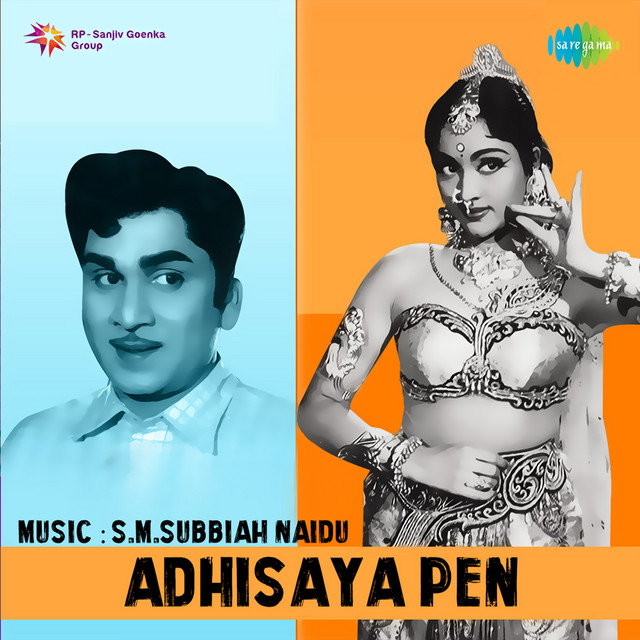
- Athisaya Penn
- Movie release year
- 1959
- Lyrics added on
- 28 Jul 2020
Lyrics & meaning
Beyond the translation
Overall song meaning
The song begins with a brief, reflective plea about the unceasing plight and tears of the poor despite changing times. It quickly transitions into a lighthearted, satirical monologue exploring the concept of 'pillai' (which refers to young offspring of plants, animals, or human children). The speaker playfully lists various young creatures from nature—such as baby squirrels, coconut saplings, parrot chicks, and mongoose cubs. The lyricist then humorously zeroes in on 'Manivannan', declaring that nowhere on this broad earth can you find a child like him, as he refuses to learn proper manners despite constant instruction. The composition weaves playful rhymes, classical carnatic notes (swara passages), and rhythmic rhythmic beat patterns (sollukattu) into a unique comic-dramatic piece.
Writing craft
Poetic devices
Polysemy / Pun (Sledai)
“Anilpillai thennam pillai / Kili pillai keeri pillai”
The word 'pillai' is cleverly used in multiple contexts: plant saplings (thennam pillai), animal young ones (anilpillai, kili pillai, keeri pillai), and a human child or name suffix (Manivannan pola pillai).
Initial Rhyme (Monai)
“Kaalam maarina pothilum yaezhai / Kanneer maarida vagaiyilaiyo”
Matching initial consonant sounds between 'Kaalam' and 'Kanneer' in the opening couplet.
Repetition (Anaphora & Refrain)
“Anilpillai thennam pillai”
The phrase 'Anilpillai thennam pillai' is repeated as a rhythmic hook throughout the song.
Sollukattu / Konnakol (Rhythmic Vocalization)
“Thga jum Thga jum Thga jum / Thathikina jum thagida thaam”
Use of traditional rhythm syllables for comedic and musical cadence.
Did you know?
Trivia
Athisaya Penn (1959) was produced by AVM Productions as the Tamil remake of the Hindi hit film 'Asha' (1957). The song makes extensive comedic use of Tamil wordplay centered around 'pillai', combining classical Carnatic swaras with lively rhythmic konnakol elements.
Keep listening
Songs with a similar feeling
From the same album
More songs from Athisaya Penn
View albumSpot an issue?
Help us improve the lyrics or English translation.