- Lyricist
- Kannadasan
- Singer
- P. Susheela
- Music director
- K. V. Mahadevan
- Movie name
- Aathi Parasakthi
- Movie release year
- 1971
- Lyrics added on
- 12 Oct 2017
Lyrics & meaning
Beyond the translation
Overall song meaning
This devotional song from Aathi Parasakthi expresses the core philosophy of Shakta Hinduism: the oneness of the Divine Mother despite her diverse forms and names across different geographic regions. The Goddess speaks directly, identifying herself as Meenakshi of Madurai, Visalakshi of Kashi, Kamakshi of Kanchipuram, and Mariamman, the fierce protector against evil. Through an apt metaphor of water, lyricist Kannadasan illustrates that just as rivers, streams, and brooks are simply different manifestations of flowing water, the Goddess's various local names, icons, and sanctuaries all culminate in the singular cosmic force known as Om Shakti.
Writing craft
Poetic devices
Iyaippu (End Rhyme)
“Meenaakshi endra peyar enakku / Visaalaakshi endra peyar vazhakku / Kaamaakshi endra peyar enakku”
The suffix '-aakshi' is repeated across stanzas to create a melodic end-rhyme connecting the localized forms of the Goddess.
Metaphor (Uruvagam)
“Aarendrum nadhiendrum odai endraalum adhu neerodum paadhaithannai kurikkum”
Comparing the various names and forms of the Goddess to different terms for flowing water (river, stream, brook) that ultimately represent the exact same divine essence.
Yamakam / Wordplay (Puns on 'Maari')
“Nirkkum oor maari per maari karu maari uru maari”
Clever repetition of 'maari' alternating between referring to Goddess Mariamman/Karumari and the verb meaning 'changing' (town changes, name changes, form changes).
Did you know?
Trivia
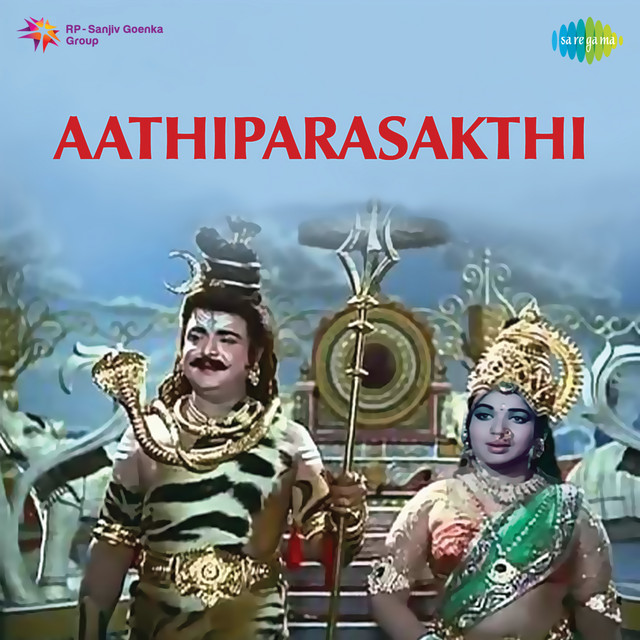
The mythological film 'Aathi Parasakthi' (1971) starred Jayalalithaa as Goddess Sakthi and Gemini Ganesan as Lord Shiva. The iconic music was composed by K. V. Mahadevan, with legendary poet Kannadasan penning the lyrics that eloquently simplify complex Shakta philosophical tenets for the mass audience.
Keep listening
Songs with a similar feeling
From the same album
More songs from Aathi Parasakthi
View albumSpot an issue?
Help us improve the lyrics or English translation.